Published by Horizon Mobile Physicians | Senior Healthcare
For most of a person's life, going to the doctor is simply part of the routine. You make an appointment, drive to the office, wait in a crowded room, and see your physician for fifteen minutes before heading back home. It is inconvenient, but it is manageable — until it is not.
For millions of seniors across the country, that routine quietly becomes one of the biggest barriers to receiving the care they need. Mobility limitations, transportation challenges, chronic fatigue, balance issues, and the physical demands of travel all make traditional office visits increasingly difficult with age. Many seniors begin skipping appointments not because they do not care about their health, but because the act of getting to care has simply become too hard.
Mobile physicians exist to solve exactly that problem. By bringing board-certified medical care directly to where seniors live — whether that is a private home, an assisted living community, or a senior residential setting — mobile physician services remove the barriers that prevent older adults from receiving consistent, high-quality healthcare. The result is not just greater convenience. It is meaningfully better health outcomes, greater independence, and a higher quality of life for the seniors who rely on this model of care.
Understanding why mobile physicians help seniors so profoundly starts with understanding what seniors are up against when it comes to accessing traditional healthcare.
Mobility limitations are among the most significant. Falls are the leading cause of injury-related death among adults 65 and older, and the fear of falling often causes seniors to limit their own movement — including the movement required to get to and from medical appointments. Seniors with arthritis, neurological conditions, hip replacements, or recovering from surgery may simply lack the physical capacity to navigate the transportation, stairs, waiting rooms, and distances that office-based care requires.
Chronic condition burden adds another layer of complexity. Most seniors are managing more than one ongoing health condition simultaneously — hypertension, diabetes, heart disease, COPD, and dementia are among the most common. Each of these conditions benefits from frequent monitoring and medication management, but the cumulative effect of managing multiple appointments, multiple specialists, and multiple care requirements can be overwhelming for both seniors and their families.
Cognitive decline creates a distinct set of challenges. Seniors with dementia or early-stage Alzheimer's disease often find unfamiliar environments deeply disorienting. The sensory stimulation of a busy medical office, the disruption to familiar routines, and the anxiety of traveling to an unknown location can make traditional appointments actively harmful for cognitively vulnerable patients — increasing agitation, confusion, and behavioral symptoms.
Social isolation compounds all of the above. Seniors who live alone or who have limited family support nearby may have no reliable way to get to medical appointments at all. Without consistent transportation, appointments get missed. Without appointments, conditions go unmonitored and unmanaged. And without management, those conditions deteriorate — often to the point of a preventable emergency hospitalization.
Mobile physician services address all of these challenges simultaneously, because they bring care to the patient rather than requiring the patient to navigate all of these obstacles to reach care.
One of the most common misconceptions about in-home doctor visits is that they are somehow less comprehensive than office-based care. The reality is the opposite. Because the physician comes to the patient's home, the visit is often more thorough, more personalized, and more informative than what is possible in a traditional clinical setting.
A typical mobile physician visit for a senior patient includes a full medical examination — vital signs, cardiovascular assessment, pulmonary evaluation, neurological screening, and a review of all current symptoms and concerns. In the home environment, the physician has access to context that a clinic visit simply cannot provide: the patient's actual living conditions, their medication storage, their fall risks, their nutrition, and the family dynamics that shape their daily care.
Medication management is a critical component of every senior visit. Polypharmacy — the use of multiple medications simultaneously — is one of the leading causes of adverse health events in older adults. A mobile physician reviews the complete medication list during every visit, checks for dangerous interactions, confirms that dosages are appropriate for the patient's current weight and kidney function, and addresses any adherence challenges that might be causing medications to be taken incorrectly or skipped entirely.
Chronic disease management is where the continuity that mobile care provides makes the biggest difference. For seniors managing conditions like heart failure, diabetes, or COPD, frequent monitoring is not optional — it is essential. A mobile physician can track weight trends that indicate fluid retention, adjust insulin dosing based on real-time blood glucose results, and modify pulmonary medications before breathing difficulties escalate into an emergency. This kind of proactive, responsive management is only possible when the physician is seeing the patient regularly and in their actual living environment. Families and caregivers who want a deeper look at this topic can explore our full guide to managing chronic conditions with in-home physicians.
Diagnostic testing at the point of care is another advantage of the mobile model. Horizon Mobile Physicians arrives equipped for in-home lab draws, EKGs, and other diagnostic assessments — meaning that a senior does not need to make a separate trip to a lab facility just to complete the workup their physician ordered. Results inform the care plan faster, treatment begins sooner, and the senior avoids another logistically difficult outing.
Coordination of care is woven throughout every visit. The mobile physician communicates directly with specialists, home health agencies, and hospital care teams to ensure that the senior's care is integrated and consistent across every setting where they receive services. For seniors managing multiple conditions with multiple providers, this coordination is one of the most valuable things a mobile primary care physician can provide.
For seniors and their families, one of the most important benefits of mobile physician services is the measurable reduction in emergency room visits and hospital readmissions that consistent in-home care produces.
Hospital readmissions among seniors are one of the most significant — and most preventable — quality and cost problems in American healthcare. Studies consistently show that a substantial percentage of Medicare patients are readmitted within 30 days of discharge, often for conditions that could have been caught and addressed during a timely follow-up visit.
The problem is that follow-up visits are precisely what seniors struggle most to accomplish after a hospitalization. When a patient has just been discharged from the hospital, they are physically weakened, often confused by new medications, and in no condition to navigate transportation to an outpatient appointment. The gap between discharge and the first follow-up visit is when things go wrong — and for seniors without mobile physician support, that gap is often much too wide.
Mobile physicians close that gap entirely. A post-discharge visit can happen within 24 to 48 hours of a senior returning home, conducted in the patient's own environment where the physician can assess not just their medical status but their functional ability, their medication understanding, and whether their home environment is safe for recovery. For seniors in Palm Beach County and across South Florida, this kind of responsive post-hospital care is one of the clearest examples of how in-home doctor visits directly protect health and prevent crisis. You can learn more about this in our detailed article on how in-home physicians help seniors after hospital discharge.
For seniors living with dementia or other forms of cognitive decline, the benefits of mobile physician services are even more pronounced. The structured familiarity of home-based care — seeing the same physician in the same comfortable environment, without the disorientation of travel and unfamiliar settings — is itself therapeutic. It reduces the behavioral symptoms that often accompany cognitive decline, makes medical assessments more accurate because the patient is calmer and more cooperative, and allows the physician to observe the patient's real cognitive environment in ways that a clinical office simply cannot replicate.
Horizon Mobile Physicians participates in the GUIDE Dementia Care Program, which provides a structured, in-home support framework specifically designed for patients and families navigating cognitive decline. This program goes beyond medical care to include care coordination, caregiver support, and community resource connections — recognizing that dementia care requires a team-based approach that encompasses the whole family, not just the patient.
For families managing a loved one's cognitive decline, the ability to receive consistent, compassionate in-home medical care from a physician who knows their loved one and their home situation is one of the most significant quality-of-life improvements available. Our article on how mobile doctors improve care for seniors with dementia explores this topic in greater depth.
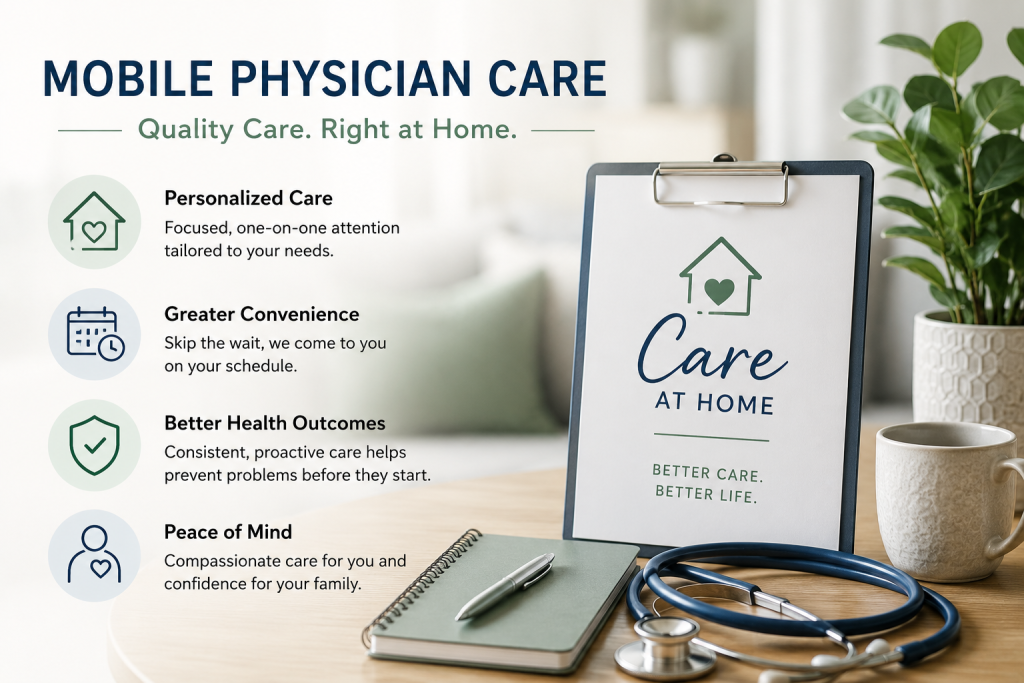
Preventive care is one of the areas where the mobile model has traditionally been underutilized — and where the opportunity for impact is greatest. Many seniors who struggle to access care for acute and chronic conditions are also not receiving the routine preventive screenings, vaccinations, and wellness assessments that could catch emerging problems before they become serious.
Mobile physicians make preventive care accessible to seniors who would otherwise fall through the gaps. Annual wellness exams, cognitive assessments, fall risk evaluations, blood pressure screenings, cancer screenings, and immunizations can all be completed during a doctor house call, without requiring the senior to organize transportation or navigate the physical demands of an office visit.
For seniors with mobility issues specifically, this preventive dimension of mobile care is among the most consequential. A fall risk assessment conducted in the patient's actual home — where the physician can identify specific hazards like loose rugs, inadequate lighting, or poorly placed furniture — is far more actionable than a generic assessment completed in a clinical environment. The physician can make specific, concrete recommendations based on what they actually see, rather than what the patient reports in an office visit. Our article on why seniors with mobility issues benefit from mobile medical care covers this dimension of in-home care in detail.
One of the most practical questions families face is knowing when to call a mobile physician and when an urgent care clinic or emergency room is the more appropriate choice. Understanding this distinction helps families use mobile physician services most effectively — and avoid unnecessary emergency department visits for conditions that can be safely and appropriately managed at home.
Mobile physician services are ideal for non-life-threatening conditions that need prompt attention: infections, minor injuries, unexpected changes in chronic condition symptoms, medication reactions, or any situation where the senior needs medical evaluation but does not require emergency intervention. For seniors with chronic conditions, a doctor house call can often resolve a concern that would otherwise result in an unnecessary emergency room visit — with all the stress, exposure risk, and cost that entails.
Emergency care remains the right choice for life-threatening symptoms: chest pain, stroke symptoms, severe difficulty breathing, major trauma, or any condition where immediate emergency intervention is required. Horizon Mobile Physicians' 24/7 clinical availability ensures that families always have a knowledgeable medical contact to help make that determination, even in the middle of the night. For a comprehensive breakdown of how to think through these decisions, our guide on when seniors should choose a doctor house call instead of urgent care provides a detailed framework.
Horizon Mobile Physicians was built around one foundational belief: that seniors deserve consistent, high-quality medical care delivered in the environment where they are most comfortable, most at ease, and most likely to thrive. Every service the practice offers — from mobile primary care and chronic disease management to concierge medicine and the GUIDE Dementia Care Program — is designed with the specific needs of older adults in mind.
Our board-certified physicians and nurse practitioners bring the full capability of a clinical practice to every home visit: comprehensive examinations, point-of-care diagnostics, medication management, specialist coordination, and 24/7 clinical support. We accept Medicare and most major insurance plans, and we serve seniors throughout Palm Beach County and South Florida — including West Palm Beach, Palm Beach Gardens, Jupiter, Boca Raton, and Stuart.
For families who are watching a parent or loved one struggle to keep up with the demands of traditional office-based care, mobile physician services are not a compromise — they are an upgrade. The combination of clinical quality, genuine continuity of care, and the comfort of the home environment produces health outcomes that office-based care, for many seniors, simply cannot match.
The goal that virtually every senior shares — and that every family wants for their loved one — is aging with dignity, independence, and consistent medical support. Mobile physicians make that goal more achievable by removing the barriers that too often prevent seniors from receiving the care they need, before small problems become serious ones.
For seniors across South Florida who are ready to experience healthcare that truly comes to them, Horizon Mobile Physicians is here. Reach out today to schedule your first in-home doctor visit and discover what a difference it makes when your physician knows not just your chart — but your home, your routines, and the life you are working to protect.
Contact Horizon Mobile Physicians at 561-817-8274 or visit our website to schedule your consultation. Our team is available to answer your questions and match you with the right care plan for your needs.
Horizon Mobile Physicians provides mobile physician services across Palm Beach County and South Florida, including West Palm Beach, Palm Beach Gardens, Jupiter, Boca Raton, and Stuart. This article is for informational purposes only and does not constitute medical advice. Always consult a qualified healthcare provider regarding your individual health needs.
Kindly take a moment to complete the form and a member of our team will reach out to you as soon as possible.
If you're currently experiencing an emergency situation, it would be best to call 911.